
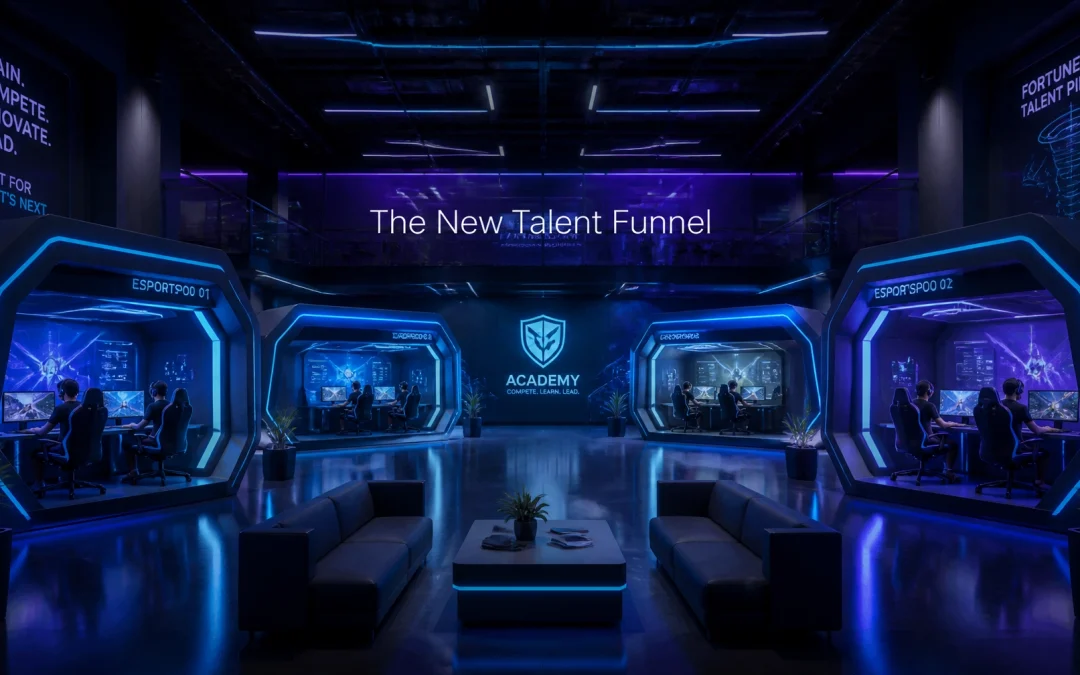
For decades, the "gold standard" of corporate recruitment has been the collegiate career fair. Picture it: a crowded ballroom, the faint smell of overpriced coffee, and thousands of students clutching glossy resumes, hoping for thirty seconds of airtime with a recruiter from a Fortune 5000 firm.
But if you ask the C-suite and media buyers at the world’s most successful companies, they’ll tell you the same thing: The traditional career fair is effectively on life support.
It’s a late-stage, low-data, and fundamentally reactive way to hire. By the time a recruiter meets a college senior, that student has already been "on the market" for years. You are fighting a bidding war for talent that your competitors have already seen. You’re chasing the market instead of making it.
At EsportsPod, we’re seeing a massive strategic pivot. Fortune 5000 brands are no longer waiting for the "finished product" at a university graduation. Instead, they are moving their talent funnel upstream: straight into high schools: through high-performance esports and simulation infrastructure.
The Reactive Recruitment Trap: Why Waiting is Losing
The traditional recruitment model is built on a "hole to fill" philosophy. You have a vacancy, you post a job, you go to a campus, and you hope the best candidates haven't already signed with your rival. This is the Reactive Funnel, and it’s costing companies millions in both sourcing fees and lost opportunity.
1. The Information Gap
A resume is a static document. In the age of AI, a resume is also increasingly commoditized. With the right prompts, any student can generate a cover letter that sounds like a Rhodes Scholar. Career fairs rely on these 30-second interactions and polished papers, which offer almost zero longitudinal evidence of a candidate’s actual problem-solving ability, collaboration skills, or persistence under pressure.
2. The Price of "Late" Talent
When you hire at the end of the supply chain (college graduation), you are paying the highest possible "acquisition cost" for that talent. You are competing with every other major brand in a high-demand, low-supply environment.

Moving Upstream: The High School Advantage
Strategic workforce development is shifting toward Proactive Engagement. By establishing a presence in high schools through EsportsPods, Fortune 5000 brands are reaching talent four to five years before their competitors even know these students exist.
Building the "Farm System" for Corporate Talent
Think of it like Major League Baseball. Teams don't wait for a 22-year-old to become a superstar before they try to sign them; they build academies. They scout early. They invest in the "farm system."
By sponsoring an EsportsPod in a high school, your brand becomes a daily fixture in the lives of the most tech-savvy, analytically-minded students in the country. You aren't just a logo on a poster at a career fair; you are the facilitator of their growth, their competitive outlet, and their educational journey.
Data Over Resumes: The EsportsPod Funnel
Why esports? Because it is the most data-rich environment on the planet. When a student engages in a high-performance simulation: whether it’s precision racing, complex team strategy, or technical flight simulation: they are generating thousands of data points.
- Cognitive Load & Decision Speed: How fast can they process information and act?
- Team Synergy: How do they communicate during a high-stress crisis?
- Persistence: Do they analyze their failures and iterate, or do they quit?
This is the ultimate guide to the Fortune 5000 talent funnel. Instead of a resume, sponsors get a behavioral profile. You can identify the top 1% of analytical thinkers in a school district by looking at their simulation performance over four years, not four minutes.

Education by Simulation: Building the Talent You Need
The most exciting part of this shift is that it isn't just about finding talent: it’s about creating it. High school esports, when done right, is a laboratory for workforce development.
Many Fortune 5000 companies are struggling to find candidates with specific STEM and soft-skill fluencies. Through EsportsPods, brands can curate "Simulation Pathways."
- Logistics & Supply Chain: Simulations that teach complex routing and efficiency.
- Advanced Manufacturing: Precision control and spatial awareness.
- Finance & Data: The rise of "Competitive Excel" and data-driven gaming.
As Eric Kelley, a finance professor and esports advisor, recently noted, competitive experiences are the ultimate differentiator. When students have a tangible story of problem-solving under pressure, they move to the front of the line. Your brand can be the one that gave them that story.
Brand Equity and Fanz®
Marketing to Gen Z and Gen Alpha requires more than just impressions; it requires authenticity. When a brand supports a high school's esports program, they aren't just "advertising": they are providing the tools for students to pursue their passions.
This creates an immense level of brand loyalty. Through the Fanz® ecosystem, sponsors gain exclusive media rights within the digital and physical spaces where students spend their time.
- Direct Space for Your Brand: Your logo isn't just on a wall; it’s integrated into the UI of the simulation environment.
- Fanz® Loyalty: Students and their families recognize the brand that funded their lab. This creates a "halo effect" that lasts long into their professional careers.

CSR and DEI: The Double-Win Strategy
For C-level executives, moving the talent funnel into high schools also solves a critical Corporate Social Responsibility (CSR) and Diversity, Equity, and Inclusion (DEI) challenge.
The digital divide is real. Many students in underfunded districts don't have access to the high-end hardware required to develop 21st-century technical skills. By sponsoring EsportsPods, Fortune 5000 companies are directly bridging this gap.
You are providing "Education by Simulation" to diverse populations, ensuring that your future talent pool is as diverse as the world it serves. This isn't just "feel-good" PR: it is a strategic investment in a broader, more robust workforce.
ROI: Comparing the Funnels
| Dimension | Traditional Career Fair | High School EsportsPod Funnel |
|---|---|---|
| Timing | 6–12 months before hire | 4–5 years before hire |
| Data Quality | Self-reported (Resumes) | Longitudinal (Simulation Data) |
| Engagement | One-off, 30-second chat | Multi-year brand integration |
| Skill Building | Passive (Selection only) | Active (Development through Fanz®) |
| Brand Loyalty | Low (Price-driven) | High (Facilitator-driven) |
| Cost | Opex-heavy (Recurring events) | Strategic Capex (Long-term pipeline) |
The Future of the Funnel
Why advertise with the old methods when you can revolutionize your recruitment strategy? The inevitability of this trend is clear: the brands that "own" the high school space today will own the talent market tomorrow.
The opportunity to partner with EsportsPod allows Fortune 5000 companies to maximize their exposure, secure exclusive media rights, and: most importantly: build a verified, data-backed talent pipeline that competitors can't touch.
Are career fairs dead? Not quite yet. But they are becoming a secondary tactic in a much larger, more sophisticated strategy. The real winners are moving upstream. They are moving into the pods. They are engaging the Fanz®.
Is your brand ready to lead the simulation?